We empower you in AI-driven software development
Why start your AI journey with us?
Because you get a proven setup
You receive a fully functional development environment: rule sets, skills, system integrations, automated tests, and defined release points. Proven in our own development, not just designed on the drawing board.
Because you can continue working without us
The goal is independence, not dependence. You’ll receive the environment, documentation, and knowledge to further develop both on your own—the same approach we take with our source code: no hidden lock-in effects.
Because quality remains measurably assured
More code in less time does not automatically mean better code. We firmly embed automated quality gates and human approval points into the process—following the same clean code standards we’ve adhered to for over 15 years.
How prepared is your development department for working with AI?
A concise assessment of your development department: What’s in use, what’s working, and what’s missing? You’ll receive an evaluation and a prioritized roadmap—a low-barrier entry point if you’re not yet sure where to start.
Which AI services we offer

We empower your development team in AI-driven software development: selecting the right tools and models, prompt and context engineering, agent-based work with your own harness, integrating existing code, as well as quality assurance and best practices. We work directly on your own codebase, not on examples. Upon request, an experienced developer will then support your team directly on the project for several weeks.
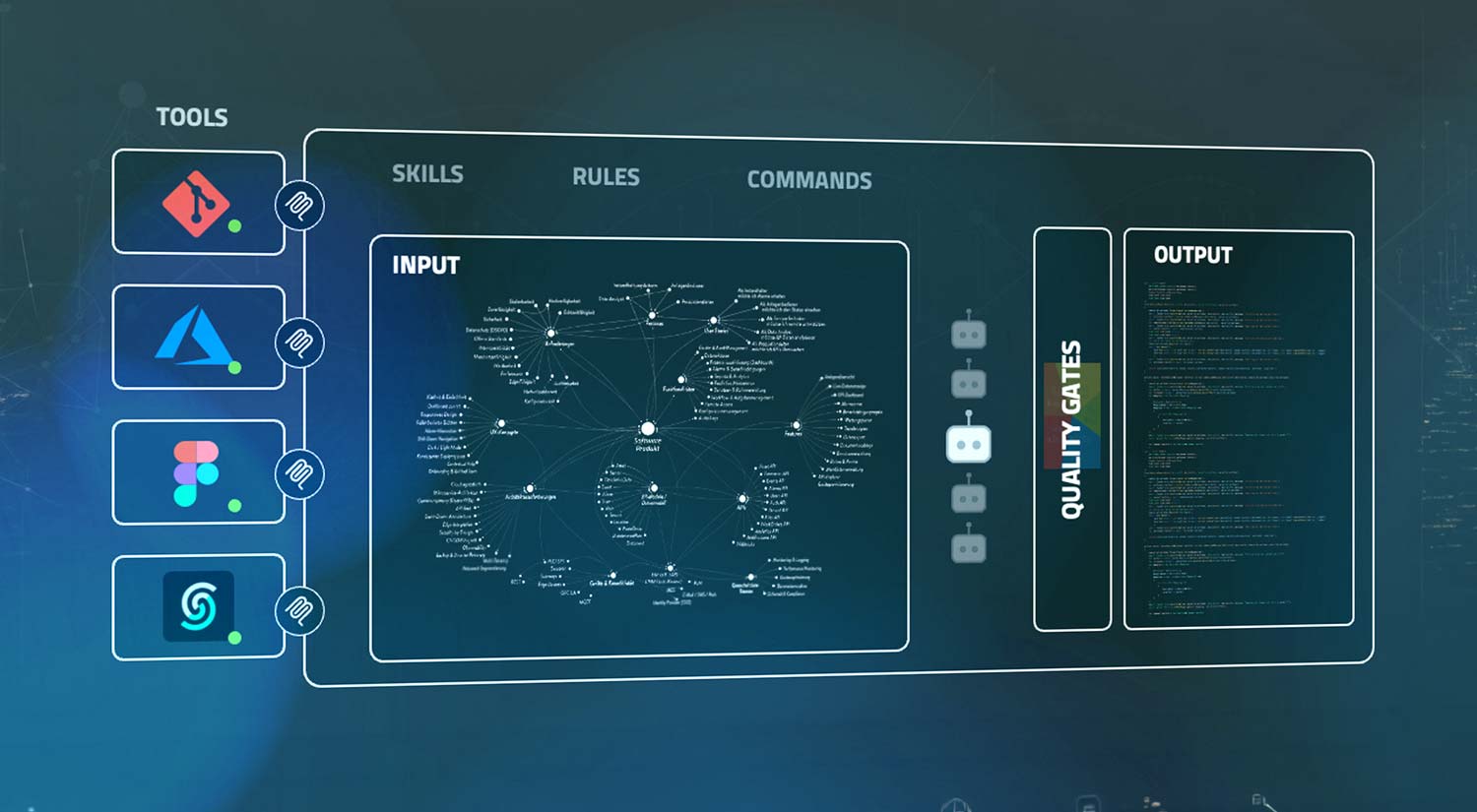
The secure development environment for AI agents: rule sets, skills, orchestration, guardrails, and hooks. Modular in design – ranging from a lean starter setup for individual teams to an enterprise-wide platform.

AI agents are only as good as their context. We structure your project knowledge in a machine-readable format: architectural decisions, requirements, coding standards, glossary, and templates – the foundation that enables agents to understand your domain.

We integrate your existing toolset with the agents – Azure DevOps, Jira, Confluence, Figma, or your own systems via MCP. This way, agents work with your actual data rather than assumptions.

Automated checks and clearly defined human approval points: What can an agent decide on its own, what needs to be reviewed, and where does a gate block the merge? This ensures that speed doesn’t come at the expense of code quality.
Book a discovery call now
The most common questions about our AI services and AI enablement
Is our source code used to train AI models?
Not if the setup is correct. The Business and Enterprise plans from major providers exclude training with customer code – though with some tools, this only applies if the corresponding mode is explicitly enabled. This is exactly where gaps arise in practice: A single developer on a personal plan can circumvent any policy. We’ll set up the environment together with your team so that the configuration doesn’t depend on any one individual, review the data processing agreements of the providers used, and document which data flows where.
Our developers have long been using AI on their own. Is that a problem?
It’s the norm. According to the Stack Overflow Developer Survey, over 80 percent of developers use AI tools or plan to—regardless of whether it’s officially permitted. A ban does little to change this; it merely shifts usage to places where you can no longer see it: private accounts, free plans, and no record of which code has left the company. The more effective approach is an approved path that’s more convenient than the unofficial one. That’s exactly what we’re building with you.
There are studies suggesting that developers don’t actually work any faster with AI. How does that fit with what you’re saying?
Those studies are correct—when it comes to unstructured work. Anyone who just starts generating code without rules, without a curated context, and without automated checks saves time on writing but loses it on reviewing. Sometimes more than they saved in the first place. The difference lies not in the model, but in the environment: A well-designed harness with binding conventions, a maintained project context, and automated quality gates ensures that not much unusable code is produced in the first place—and that what is produced can be tested much faster. Our own experience since 2025 shows that under these conditions, we’re up to three times faster at coding.
How do we prevent ourselves from accumulating technical debt?
By ensuring that quality doesn’t depend on the good will of individuals, but is embedded in the process. AI amplifies existing practices—both good and bad. Where no architectural rules applied before, violations now arise more quickly. That’s why we define which standards apply before the rollout and enforce them technically: through automated checks during the build, defined release points, and a set of rules that the agent must also follow. Anything that fails the check does not make it into the main branch.
Will this also work with our existing legacy code?
Yes, and that’s often where the greatest impact lies. AI agents are good at making sense of unfamiliar code, revealing connections, and filling in gaps in testing and documentation – tasks that regularly get left undone in day-to-day work. The prerequisite is that the agent knows clear boundaries: Which areas is it allowed to touch, which architectural rules apply, and where is the interface with the rest of the system? We define exactly these boundaries together before we start working with the existing code.
Our experienced developers are skeptical. How do you handle that?
We take that skepticism seriously because it’s usually justified. The concern is rarely “AI will replace me,” but rather “I’ll become the person responsible for reviewing code I didn’t write.” That’s why we don’t rely on lecture-style training, but instead use real tasks from your project and involve experienced developers early in the design process: They define the rules, the architectural boundaries, and the checkpoints. Those who set the guidelines themselves are more likely to trust the result.
How do we measure whether using AI was worth it?
Focus on results, not usage metrics. The number of active licenses or the amount of code generated by AI tells us very little. What truly matters is how much of that code remains unchanged in the system after several weeks, how lead times and error rates evolve, and how the team itself evaluates the work. We define these key performance indicators together at the outset—ideally before the rollout begins, as you lose your baseline for comparison once it’s underway.
What exactly is an agent harness?
The language model is the engine; the harness is the vehicle, the road, and the traffic rules. It encompasses everything that makes a model usable within the company: rule sets, integration with your tools, workflow control, guardrails, logging, and approval points. The vast majority of the impact comes from here—not from the model itself.