Software quality audits & development process audits

We audit the quality of your code, software, and processes – whether it’s existing software or a new development. Our audits:
Customer since 2005
Customer since 2022
Customer since 2008
Customer since 2022
Customer since 2022
Customer since 2017
Customer since 2019
Customer since 2012
Customer since 2018
Customer since 2012
Customer since 2018
Customer since 2024
Customer since 2005
Customer since 2016
Customer since 2023
Customer since 2005
Customer since 2022
Customer since 2008
Customer since 2022
Customer since 2022
Customer since 2017
Customer since 2019
Customer since 2012
Customer since 2018
Customer since 2012
Customer since 2018
Customer since 2024
Customer since 2005
Customer since 2016
Customer since 2023
Customer since 2005
Customer since 2022
Customer since 2008
Customer since 2022
Customer since 2022
Customer since 2017
Customer since 2019
Customer since 2012
Customer since 2018
Customer since 2012
Customer since 2018
Customer since 2024
Customer since 2005
Customer since 2016
Customer since 2023
Your benefits

Why book a software quality audit by generic.de?

Because you gain certainty about AI-generated code

With AI, code is now generated in days instead of months – but you can’t tell just by looking at it whether it’s ready for production. We examine what lies behind functioning user interfaces: architecture, security, test coverage, and maintainability.

Because you gain clarity and confidence in your software

Whether developed with AI or not, you’ll receive a well-founded assessment of the codebase and development processes—including technical debt, UX weaknesses, and risks to quality and process reliability.

Because you benefit from our Clean Code expertise

All of our testers and auditors are certified Clean Code developers—with many years of experience in complex industrial and business applications. That is the standard by which we measure your software.
Tobias Vock
Manager Solutions
SAATMANN GMBH
We had put a lot of thought into our new software. But to make sure we're on the right track, we didn't just want to rely on internal expertise. The qualified software audit from generic.de really helped us with the rest of the process.
OUR APPROACH

How we audit your software quality

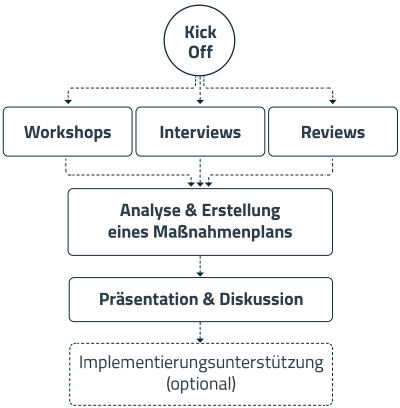
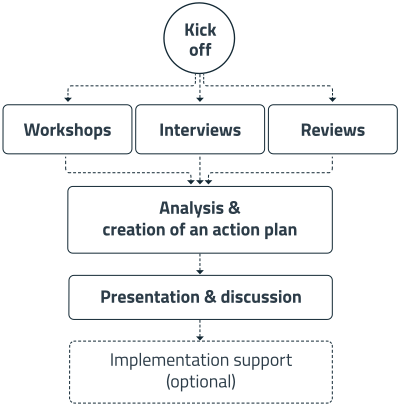
Horizontales Ablaufdiagramm des Software-Quality-Audits: Links ein Kreis „Kick-off“. Von dort führen gestrichelte Pfeile zu drei parallel angeordneten Kästen „Workshops“, „Interviews“ und „Reviews“. Alle drei münden in einen großen Kasten „Analyse & Erstellung eines Maßnahmenplans“. Ein Pfeil weist weiter auf „Präsentation & Diskussion“. Rechts schließt ein gestrichelter Kasten „Implementierungs­unterstützung (optional)“ den Prozess ab.Horizontal flowchart of the software quality audit: On the left is a circle labeled “Kick-off.” From there, dashed arrows lead to three boxes arranged in parallel: “Workshops,” “Interviews,” and “Reviews.” All three lead to a large box labeled “Analysis & Creation of an Action Plan.” An arrow points to “Presentation & Discussion.” On the right, a dashed box labeled “Implementation Support (optional)” completes the process.Vertikales Ablaufdiagramm des Software-Quality-Audits: Oben ein Kreis „Kick-off“. Von dort führen gestrichelte Pfeile zu drei parallel angeordneten Kästen „Workshops“, „Interviews“ und „Reviews“. Alle drei münden in einen großen Kasten „Analyse & Erstellung eines Maßnahmenplans“. Ein Pfeil weist weiter auf „Präsentation & Diskussion“. Rechts schließt ein gestrichelter Kasten „Implementierungs­unterstützung (optional)“ den Prozess ab.Vertical flow chart of the software quality audit: At the top is a circle labeled “Kick-off.” From there, dashed arrows lead to three boxes arranged in parallel: “Workshops,” “Interviews,” and “Reviews.” All three lead to a large box labeled “Analysis & Creation of an Action Plan.” An arrow points to “Presentation & Discussion.” On the right, a dashed box labeled “Implementation Support (optional)” completes the process.
Your benefits at a glance:
  • Objective feedback on code quality, architecture, and development processes
  • Reliable assessment of whether AI-generated code is production-ready
  • Clear recommendations for scalability, maintainability, and performance
  • Future security through best practices and modern technologies
  • Increased software quality & less technical debt
get in touch now
Continue to the enquiry form.
OUR OFFER

We audit your software solutions

AI Code Audit: AI-generated code / Vibe Coding

Your team or a service provider has developed software using AI – and you want to know what you have actually received. We analyze AI-generated code for architecture, security, test coverage, and maintainability. Typical of "vibe coding": software that works, but isn't production-ready. In the end, you will know what is viable, what needs rework, and what is better off being rebuilt from scratch.
‍

Exemplary Methods
  • Scope & Provenance Clarification: which parts were created with AI support, under what guidelines, and using which tools
  • Static Analysis & Security Scan: automated checks for vulnerabilities, risky dependencies, and license conflicts
  • Pattern Review: we specifically look for weaknesses typical of AI – redundant abstractions, inconsistent conventions, and missing or generic error handling
  • Test Substance Review: do the tests actually verify behavior, or are they just mirroring the code?
  • Production Readiness Check: interfaces, data management, rights and roles concepts, hosting, CI/CD, monitoring, rollback capabilities, as well as audit, compliance, and SLA requirements
  • Verdict & Action Plan: we give you a clear assessment of what is viable, what needs rework, and what is better off being rebuilt from scratch – including effort estimates
inquire now
Continue to the enquiry form.
Architecture Audit: Codebase, Legacy Systems & Scalability

How sustainable is your established codebase? We analyze source code, architecture, and technology stacks—from legacy systems to modern applications. The audit uncovers technical debt, evaluates scalability and performance, and demonstrates how effectively your software can be evolved.
Example Methods
  • Goal Refinement: we clarify the scope, quality scenarios, and stakeholder objectives
  • In-Depth Code & Architecture Analysis: static code scans, ATAM-based architecture reviews, technology stack checks, as well as security and performance profiling
  • Assessment of Future Viability: how easily can the codebase be modified in the future—by your team and by the AI agents increasingly working on it
  • Findings Report & Risk Matrix: prioritized technical debt, metrics (e.g., cyclomatic complexity, hot-path latency), and quick wins
  • Action Workshop: together, we develop a roadmap with effort estimates and refactoring packages so your team can start implementation immediately
inquire now
Continue to the enquiry form.
UX/UI Audit: User Experience & User Interface

How intuitive is your application? We analyze the user journey, user experience, and user interfaces. Our UX audit uncovers weaknesses in user guidance and provides clear recommendations to improve usability, conversion, and customer satisfaction—specializing in professional work contexts (Enterprise UX).
Example Methods
  • Stakeholder Alignment & Goal Definition: we gather business goals, user feedback, and—if available—metrics such as conversion rates or NPS
  • Heuristic & Data-Driven Analysis: expert reviews based on Nielsen heuristics, click-path analysis, heatmaps, and session replays
  • Usability Testing & Persona Check: task-based testing with core personas to objectively identify friction in user flows
  • UX Scorecard & Recommendations: we weight findings based on their impact on satisfaction, conversion, and development effort
  • Review Sprint: we optionally support your UX team during their work and testing phases
inquire now
Continue to the enquiry form.

We audit your development processes

AI Dev Audit: AI development process & development environment

Your team is working with Claude, Cursor, or Copilot – but no one knows if it’s actually going well. We audit your AI-supported development process: How are agents integrated, which rules and guardrails are in place, and where do humans and automated quality gates perform checks? To do this, we evaluate your development environment using harnesses and MCP connections.
‍

Exemplary methods
  • Tool & usage inventory: which AI tools are in use, how are they configured, and who uses them and how regularly?
  • Harness & guardrail review: rule files, skills, MCP connections, hooks, and automations – and the question of how much of this is standardized across projects.
  • Human and agent role model: where do humans make decisions and perform checks, where do agents operate autonomously, and where are checkpoints missing?
  • Quality gates & pipeline: which checks run automatically, which gates actually block, and which are regularly bypassed
  • Compliance & data protection: handling of source code and customer data, vendors used, and contractual safeguards
  • Maturity assessment & enablement plan: prioritized areas for action plus suggestions for training and onboarding your teams
Inquire now
Continue to the enquiry form.
Requirements Audit: Requirements Engineering & Backlog Quality

Great software starts with clear requirements. We examine how requirements, bugs, and features are captured, prioritized, and translated into user stories. This becomes even more critical when AI agents are involved: they reliably build exactly what is specified—including any gaps. Our audit reveals where unclear requirements will lead to costly rework later on.
Exemplary methods
  • Requirements Inventory & Stakeholder Interviews: we examine how knowledge is gathered (workshops, documents, systems) and benchmark it against best practices
  • Backlog Quality Check: analysis of completeness, consistency, testability, and prioritization
  • Suitability for AI Agents: are requirements and acceptance criteria formulated clearly enough to reliably generate software?
  • Traceability & Tool Review: we evaluate the links to epics, tests, and architectural artifacts, as well as tool integration
  • Maturity Scoring & Gap Analysis: we visualize the maturity level of your requirements and identify quick wins (e.g., review guidelines, Definition of Ready checklists)
  • Improvement Roadmap: concrete measures including templates, workshop series, and recommendations to ensure requirements flow into development with fewer errors in the future
Inquire now
Continue to the enquiry form.
Delivery audit: development process, pipelines & collaboration

Is your software development running efficiently? We analyze processes, roles, and collaboration – from planning and review to CI/CD pipelines and the definition of done. This is especially relevant when AI-assisted development leads to more code in less time: where are review bottlenecks forming, where are quality gates missing, and are the right roles involved in the right places?

Exemplary methods
  • Maturity assessment: we capture team dynamics, evaluate process adherence, and examine technical practices
  • Ceremony & pipeline review: observing stand-ups, plannings, retros, CI/CD pipelines, and adherence to the definition of done to uncover gaps between ambition and practice
  • Metric benchmarking: velocity stability, lead and cycle times, defect escape rate, flow efficiency – supplemented by qualitative interviews
  • Review capacity: when more code is produced in less time, the bottleneck shifts to the review process. We assess whether your process can handle this volume
  • Maturity heatmap & areas for action: we prioritize gaps based on business impact and develop an improvement plan
  • Coaching & follow-up measurement: upon request, we support change initiatives and measure progress iteratively
Inquire now
Continue to the enquiry form.
Our references

Selected case study

SAATMANN GMBH

Tech audit of a newly developed QA software in healthcare

How we tested the newly developed QS Monitor software from Saatmann GmbH in terms of source code quality and system architecture.

Request software audit now

If you would like to know which data we process and how long we store it, you can find further information in our Privacy statement.
Your data is transmitted in encrypted form
Thank you so much! We have received your contact request!
Oh no! Something went wrong. Please try again!
Jörg Lenz
Key Account Manager
faqs

The most common questions about our software quality audits

When is the best time for a software quality audit?

A software audit is recommended...

  • when a large amount of code has been generated in a short time using AI tools and you want to know what is actually viable.
  • before you move an AI-built prototype into production.
  • when it is unclear whether your legacy system needs or should be modernized.
  • shortly before a software modernization to gain clarity on risks and effort.
  • before major release milestones or migrations, or when performance or security issues arise.
  • as a "health check" after 12–18 months of product operation.

How long does an audit take and when are the results available?

For a compact scope (e.g., backend code only), we deliver initial insights within 5-10 days; comprehensive reviews of frontend, backend, and processes typically take two to four weeks.

What results will I get at the end?

We will clarify together at the kick-off which results and artifacts are useful. Typical artifacts are:

  • detailed report & final presentation
  • Code metrics
  • Risk matrix
  • UI screenshots with explanations
  • Process gaps
  • Quick Wins
  • Fields of action
  • prioritized catalogue of measures

What role does clean code play in the tech audit?

All auditors are certified clean code developers. Specifically for the tech and dev audit, this means that evaluations are based on SOLID principles, readability, testability, and easy extensibility.

When it comes to AI-generated code, this standard is particularly important: agents produce syntactically clean code that can still be difficult to maintain—for example, due to redundant abstractions, inconsistent conventions, or tests that only pass on a formal level. Clean code criteria reveal such weaknesses that a purely functional test would miss.