Clean Code training for your dev team

Practical, certified, individually tailored to your requirements

Duration: 4 working days

2 trainers per course

For 8 to 10 participants

With you or with us

1,924€ per participant

CHALLENGES

Why Clean Code?

Increase the efficiency of your processes

Our AI solutions automate time-consuming tasks, analyze data in real time and help you optimize processes in a targeted manner and make better use of resources.

Take quality assurance to the next level

With AI-based analysis, you can identify deviations early on, ensure consistent product quality and reduce waste through precise, data-based decisions.

Set yourself apart from the competition

Rely on individual AI solutions that create real added value — from smart automation to data-driven services that strengthen your competitiveness.

YOUR BENEFITS

Why book Clean Code training with generic.de?

Because you learn clean code from practice & for practice

Our training is based on Clean Code expertise from over 15 years of project business. Benefit from practical experience as well as tried and tested methods and tools that can be transferred directly to everyday work.

Because our trainers are certified experts

Our Clean Code trainers were personally trained by Stefan Lieser, one of the co-founders of the Clean Code Development Initiative. In this way, we guarantee the highest quality and in-depth expertise.

Because our training is perfectly tailored for you

We tailor the content and structure of the training specifically to your level of knowledge. In addition, you decide when, for how long, and where the training should take place. Perfectly integrated into your business process.

Clean code development from practice for practice

Our training is based on clean code expertise from over 15 years of project business. You benefit from practical experience that can be transferred directly to everyday working life.

More than 15 years of Clean Code as corporate DNA

Clean Code has been an integral part of our corporate culture since 2010. Our trainers authentically pass on this knowledge and mindset in Clean Code training courses.

Practical toolbox, instead of a theory hammer

For us, doing comes first. Our trainers reduce the theoretical part to a minimum and provide participants with methods and tools that have proven effective in everyday life.

Certified trainers with strong backgrounds

Our Clean Code trainers are from Stefan Lieser, one of the co-founders of the Clean Code Development Initiative, personally trained. In this way, we guarantee the highest quality and in-depth expertise.

Individual training tailored to your team

We tailor the content and structure of the training specifically to your level of knowledge — for maximum learning effect and sustainable transfer of knowledge. Whether you're a beginner or an advanced user, we'll pick you up right where you are.

Training with maximum flexibility

You decide when, How long, where and like The training should take place: On site at your site, in our modern training rooms or remotely via video conference. This allows training to be perfectly integrated into your operational process.

Companies that we have already trained

HAFNER Logo
The approach of specifically reducing dependencies in code was explained in a comprehensible and practice-oriented manner. I also found the attitude of gradually improving things locally — instead of making major changes. This pragmatic approach is realistic and effective.

TRAINING PARTICIPANTS
FEBRUARY 2025
I went to this school myself several years ago. I was stuck up to my neck, almost motionless in the brownfield mess. generic.de showed me a way out of this misery and then (re) greedily followed it. It is now clear to me that this path has permanently changed myself and the way I develop software and has made me better and happier as a developer. I can only encourage anyone interested and doubting: go this route, you won't regret it!

Frank Rabold
Senior Software Developer, AppSphere AG
The strong practical orientation with the tasks and joint coding helped a lot to make the content understandable. The homework and its review also helped me a lot.

TRAINING PARTICIPANTS
FEBRUARY 2025
Really good work. Far exceeded my expectations.
I will be able to take with me and use a great deal.

TRAINING PARTICIPANTS
AUGUST 2024
I went to this school myself several years ago. I was stuck up to my neck, almost motionless in the brownfield mess. generic.de showed me a way out of this misery and then (re) greedily followed it. It is now clear to me that this path has permanently changed myself and the way I develop software and has made me better and happier as a developer.

Frank Rabold
Senior Software Developer, AppSphere AG
Der Ansatz, Abhängig­keiten im Code gezielt zu reduzieren, wurde nachvollziehbar und praxisorientiert erklärt. Besonders positiv fand ich auch die Haltung, Dinge lokal schrittweise zu verbessern – statt große Umbrüche zu machen. Dieser pragmatische Ansatz ist realistisch und effektiv.

SCHULUNGSTEILNEHMER 
FEBRUAR 2025
The approach of specifically reducing dependencies in code was explained in a comprehensible and practice-oriented manner. I also found the attitude of gradually improving things locally — instead of making major changes. This pragmatic approach is realistic and effective.You live it.

TRAINING PARTICIPANTS
Team Lead & Principal Software Engineer, adesso Schweiz AG
Really good work. Far exceeded my expectations.
I will be able to take with me and use a great deal.

TRAINING PARTICIPANTS
AUGUST 2024
The strong practical orientation with the tasks and joint coding helped a lot to make the content understandable. The homework and its review also helped me a lot.

TRAINING PARTICIPANTS
FEBRUARY 2025
OUR APPROACH

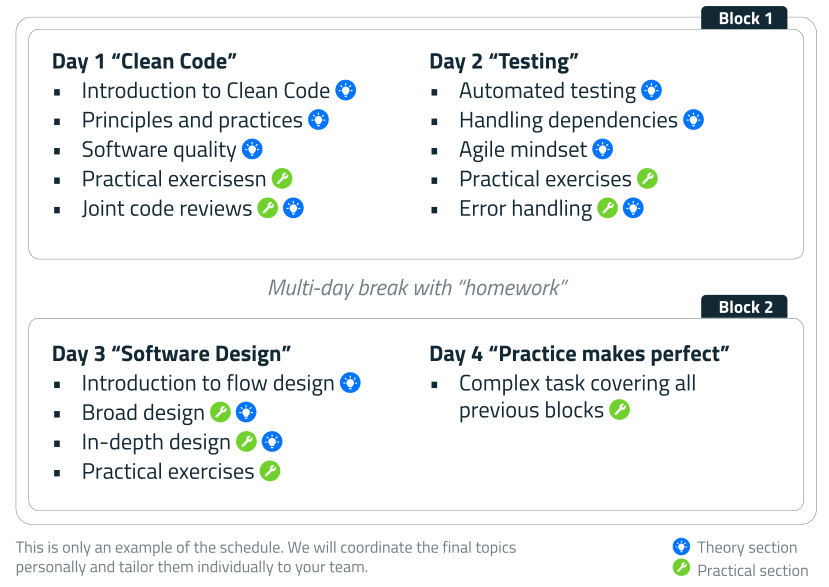
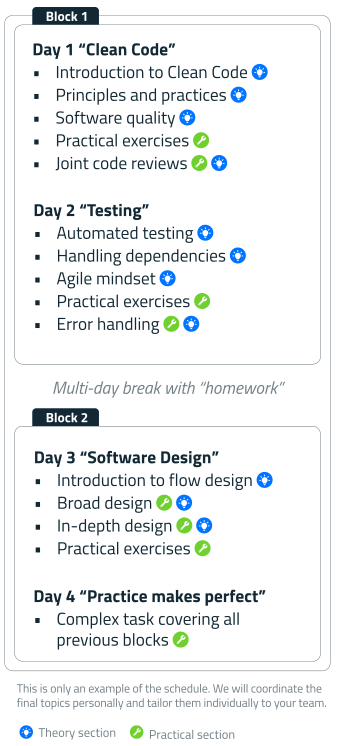
Exemplary training process

Schaubild Schulungsablauf: 

Tag 1 „Clean Code“
Einführung in Clean Code  
Prinzipien und Praktiken  
Software-Qualität  
Praktische Übungsaufgaben  
Gemeinsame Code Reviews   

Tag 2 „Testing“
Automatisiertes Testen  
Behandeln von Abhängigkeiten  
Agiles Mindset  
Praktische Übungsaufgaben    
Fehlerbehandlung    

Mehrtägige Pause mit „Hausaufgaben“

Tag 3 „Software Design“
Einführung in Flow Design  
Entwurf in die Breite    
Entwurf in die Tiefe    
Praktische Übungsaufgaben  

Tag 4 „Übung macht den Meister“
Komplexe Aufgabe, die alle bisherigen Blöcke abdeckt  

Ablauf nur exemplarisch. Die finalen Themen stimmen wir persönlich ab und passen sie individuell auf Ihr Team an.Training schedule overview: 

Day 1 “Clean Code”
Introduction to clean code  
Principles and practices  
Software quality  
Practical exercises  
Joint code reviews   

Day 2 “Testing”
Automated testing  
Handling dependencies  
Agile mindset  
Practical exercises    
Error handling    

Multi-day break with “homework”

Day 3 “Software Design”
Introduction to flow design  
Broad design    
In-depth design    
Practical exercises  

Day 4 “Practice makes perfect”
Complex task covering all previous blocks  

This is only an example of the schedule. We will coordinate the final topics personally and tailor them individually to your team.Schaubild Schulungsablauf: 

Tag 1 „Clean Code“
Einführung in Clean Code  
Prinzipien und Praktiken  
Software-Qualität  
Praktische Übungsaufgaben  
Gemeinsame Code Reviews   

Tag 2 „Testing“
Automatisiertes Testen  
Behandeln von Abhängigkeiten  
Agiles Mindset  
Praktische Übungsaufgaben    
Fehlerbehandlung    

Mehrtägige Pause mit „Hausaufgaben“

Tag 3 „Software Design“
Einführung in Flow Design  
Entwurf in die Breite    
Entwurf in die Tiefe    
Praktische Übungsaufgaben  

Tag 4 „Übung macht den Meister“
Komplexe Aufgabe, die alle bisherigen Blöcke abdeckt  

Ablauf nur exemplarisch. Die finalen Themen stimmen wir persönlich ab und passen sie individuell auf Ihr Team an.Training schedule overview: 

Day 1 “Clean Code”
Introduction to clean code  
Principles and practices  
Software quality  
Practical exercises  
Joint code reviews   

Day 2 “Testing”
Automated testing  
Handling dependencies  
Agile mindset  
Practical exercises    
Error handling    

Multi-day break with “homework”

Day 3 “Software Design”
Introduction to flow design  
Broad design    
In-depth design    
Practical exercises  

Day 4 “Practice makes perfect”
Complex task covering all previous blocks  

This is only an example of the schedule. We will coordinate the final topics personally and tailor them individually to your team.
request now
Continue to the enquiry form.
OUR CLEAN CODE TRAININGS

Learning objectives, content & our trainers

Learning objectives

Building a common understanding of software quality
Introduction to the Clean Code Development Initiative
Practical techniques to get from requirement to source code (flow design)
The most important clean code development principles and practices in theory and practice
Practical introduction to writing tests and developing complex test suites
Communicating the clean code mindset in terms of collaboration, efficiency and correctness

Contents

Clean Code Development
  • The Clean Code values
  • The 5 degrees
  • Principles & Practices
  • Clean Code Mindset
Software quality
  • Difference between internal and external software quality
  • What does sustainable software development mean
Clean Code principles
  • Single Responsibility Principle (SRP)
  • Don't Repeat Yourself (DRY)
  • Integration Operation Segregation Principle (IOSP)
  • Keep It Simple, Stupid! (KISS)
  • You Aint Gonna Need It (YAGNI)
Clean Code practices
  • version control
  • Automated testing
  • Test-first
  • Code Reviews
  • Boy Scout Rule
  • Daily reflection
Automated testing
  • Code structure for good testability
  • Test pyramid
  • Test strategies
  • System, integration, unit testing
Dependencies
  • Typical structures
  • challenges
  • Dependencies and testability
Flow Design
  • The essential steps
  • Incremental development
  • Breakdown of requirements
  • Draft in width
  • Draft in depth
  • Implementation of a draft
Agility
  • Agile mindset
  • Agile values
  • Clean code & agile frameworks
Exercises & reviews
  • Smaller “katas” to apply the theory you have learned in practice
  • Larger exercises to train team collaboration
  • Joint reviews of results and sample solutions
  • Group and individual exercises

Our Clean Code trainers

Thomas Fröhle
Clean Development trainer
Focus on what you need right now and don't try to solve problems now that could potentially arise at some point.
Felix Ruthenberg
Clean Development trainer
Code checks are a very good start to find out where a company stands with its code base. In the end, the truth is always in the code.
Our trainers were trained by Stefan Lieser, managing director of CCD Academy GmbH and co-founder of the Clean Code Development Initiative.

Request Clean Code training now without obligation

If you would like to know which data we process and how long we store it, you can find further information in our Privacy statement.
Your data is transmitted in encrypted form
Thank you so much! We have received your contact request!
Oh no! Something went wrong. Please try again!
Jörg Lenz
Key Account Manager
faqs

The most common questions about our Clean Code training

Who is Clean Code training suitable for?

Our Clean Code training courses are aimed exclusively at people with programming know-how. In other words, to software developers, system and software architects, or software testers.
However, our trainers also offer presentations at management level, where they discuss the benefits of clean code development from a business perspective. Our CTO Sebastian Betzin explains how Clean Code can contribute to corporate success in the following on-demand video:

What previous knowledge do you need for Clean Code training?

As I said, programming know-how is required to be able to follow the courses. Participants must understand programming examples in C#, Java, Typescript, etc. and also be able to write the languages.

What training do we need to bring with us?

Especially for practical exercises, all participants should have a computer with an installed development environment, such as VSCode or VisualStudio, bring along.

How long does clean code training take?

That depends entirely on you and your wishes. We adapt the length of our Clean Code trainings to your learning goals. These can be one-day workshops or sessions over several days.

Where do the training courses take place?

That is also up to you. Either you come to us in Karlsruhe or our Clean Code trainers come to your company and hold in-house trainings with your team.

How can I book a Clean Code training?

Just write to us via the contact formthat you're interested in Clean Code training, and we'll get back to you. If you already know when you would like to take part in the training, how many participants there will be and what learning goals you are pursuing, simply enter this information in the appropriate free text field.

The Clean Code Shop

Clean Code wristbands, overview posters, information flyers, writing pads and much more. In our Clean Code Shop, you will find everything you need for the Clean Code Developer.

You might also be interested in this

Clean Code
9.9.21

Clean Code Development: The Grades

Clean code development is divided into different grades, which you as a developer climb one by one and repeat in an eternal cycle

Clean Code
9.9.21

Clean Code Development: The Virtues

To become a Clean Code Developer, you need to internalize a number of virtues: Appreciate variation, only do the bare minimum, isolate aspects etc.

Clean Code
7.9.21

Clean Code Development: The values

The value system of Clean Code Development comprises the values of evolvability, correctness, production efficiency and continuous improvement.

Clean Code
Development
7.6.17

Flow design in practice

Clean Code Development and Flow Design: What is behind the design methodology? How can flow design be applied in practice? And how useful is it?

Inhalte unserer Clean Code Trainings im Detail

Softwarequalität und Clean Code Development

Software­qualität ist nicht gleich Software­qualität. Wir unterscheiden zwischen innerer und äußerer Qualität, wobei das Augen­merk unserer Clean Code Schulung auf der inneren Qualität liegt - also auf der Qualität des Quell­codes. Adressiert werden die Themen Lesbarkeit, Nach­voll­zieh­barkeit, Test­barkeit und Wandel­barkeit (Evolvier­barkeit).

Die Vorteile eines gemeinsamen Qualitäts­bewusstseins:

  • Optimale Grundlage der Zusammen­arbeit
  • Gesteigerte Sensibilität für ökonomische Zusammen­hänge
  • Besseres Verständnis der Folgen schlechter Code­qualität

Die Clean Code Development Initiative und das Werte­system

Die Clean Code Development Initiative gründet auf dem Buch Clean Code von Robert C. Martin. Darauf auf­bauend haben die zwei deutschen Ent­wickler Stefan Lieser und Ralf Westphal 2009 ein norm­­gebendes Werte­­system für Soft­ware­­ent­wickler konzipiert, das neben Lern­modulen auch eine Sammlung von Prinzipien und Praktiken beinhaltet. An oberster Stelle thronen die vier Clean Code Werte: 

  • Korrektheit
  • Wandelbarkeit
  • Produktionseffizienz
  • Kontinuierliche Verbesserung

Software Architektur mit Flow Design

Flow Design ist eine Technik, um Quell­code sinnvoll zu planen und zu strukturieren - noch bevor er geschrieben wird. Dabei geht es immer um die Frage, wie man von einer Anforderung zum tatsächlichen Code gelangt. Die Technik arbeitet dabei mit hierarchischer Zer­legung der Anforderung auf ihre kleinsten Ein­heiten: Daten­flüsse.

Die Vorteile von Flow Design:

  • Quell­code kann bis ins Detail geplant werden, ohne das Big Picture aus den Augen zu verlieren
  • Das gesamte Team wird in den Software-Design­prozess involviert
  • Positive Auswirkungen auf Verantwortlich­keiten im Team und auf die Lesbarkeit des Codes
  • Ideale Vorlage für eine durch­dachte Test­suite

Automatisiertes Testing und Testsuites entwickeln

Automatisierte Tests sorgen nicht nur dafür, dass der Quell­code korrekt arbeitet, sie sind auch ein gutes Mittel Anforderungen besser zu verstehen und zu definieren. Und sie sorgen für Vertrauen und Sicher­heit bei den Entwickler:­innen. Allerdings ist das Schreiben von Tests sowie komplexer Test­suites, bestehend aus System-, Integrations- und Unit Tests, ein Hand­werk für sich. Unsere Trainer vermitteln grund­legende Konzepte, Techniken und die nötigen Technologien, wie bspw. SonarCloud, um die Test-Coverage im Back- und Frontend zu steigern und bei Penetrationtests gute Ratings zu erzielen.

Die wichtigsten Clean Code Prinzipien

Obwohl alle Clean Code Prinzipien ihre Daseins­berechtigung und Wichtig­keit haben, gibt es Prinzipien, die eigentlich immer angewendet werden sollten und damit auch wichtiger Teil unserer Schulungen sind: 

  • SRP - „Single Responsibility Principle“: Eine Methode oder eine Klasse sollte immer nur eine Funktion haben
  • DRY - „Don’t Repeat Yourself“: Duplikate im Code sind immer zu vermeiden
  • IOSP - „Integration,Operation, Segregation Principle“: Eine Applikation ist in Funktions­einheiten aufge­gliedert, die wie in einer Kette aufgerufen werden
  • YAGNI - „You Aint Gonna Need It“: Fokus auf die jetzigen, nicht auf zukünftige, potenzielle Probleme

Der richtige Umgang mit Abhängigkeiten

Abhängigkeiten im Quellcode können dabei helfen Strukturen zu ver­ein­fachen. Zu viele Abhängig­keiten können jedoch dazu führen, dass Code-Änderungen mit unerwarteten Neben­wirkungen ein­her­gehen und der Code mit der Zeit un­über­sichtlich wird. In unseren Schulungen geben wir den Teil­nehmenden Techniken und Best Practices an die Hand, um Abhängigkeiten effektiv zu managen und wenn nötig aufzulösen.

Die Entwicklungsmethode Pair Programming

Pair Programming, Pairing oder auch Tandem-Programmierung beschreibt eine Clean Code Entwicklungsmethode, bei der zwei Entwickler:innen gleichzeitig an einem Problem und am gleichen Code arbeiten. So sinnvoll die Herangehensweise in manchen Fällen ist, so ineffizient kann sie in anderen Fällen werden. Unsere Trainer geben Best Practices, wie und wann die Methode Sinn macht.

Wann ist Code eigentlich clean genug? Die Definition of Done

Clean Code Development darf nicht zum Selbstzweck verkommen. Beschäftigt man sich mit Quellcode, wird man immer wieder Stellen finden, die man optimieren kann. Aber irgendwann ist das einfach nicht mehr produktiv und steht nicht mehr im Verhältnis zu den Kosten. Die Frage lautet nur: wann?
In unseren Clean Code Schulungen geben wir den Teilnehmenden Tools an die Hand, um zur richtigen Definition of Done zu gelangen – individuell abgestimmt auf das Projekt, die Anforderungen und auf die Unternehmensziele.

Das Clean Code Development Mindset

Genauso wichtig, wie das Hand­werkliche, ist das richtige Mind­set. Dabei geht es darum, die Clean Code Werte immer wieder aufrecht zu erhalten und auf sie hin­zu­weisen. Die Inhalte werden dem­nach nicht in einer ab­ge­schlossene Session vermittelt, sondern parallel über die gesamte Schulung hinweg. Im Detail geht es um agiles Arbeiten, Effizienz durch Fokus, Reflexion, Ver­ant­wortlichkeiten, Erwartungs­haltungen und Zusammen­arbeit.

Clean Code Trainings mit hohem Praxisteil

Nur durchs Machen, lernt man Clean Code. Deshalb legen wir sehr großen Wert auf einen hohen Praxis­anteil in unseren Schulungen. Das sind einer­seits kleine Übungs­aufgaben, um ein theoretisch besprochenes Thema zu vertiefen. Anderer­seits sind es gemeinsame Code-Reviews, in denen die Ergebnisse der Übungs­aufgaben oder andere Code-Beispiele mit allen Teil­nehmenden im Detail besprochen werden.

(Live) Code Checks einer bestehenden Applikation

Code Checks einer bestehenden Applikation sind ein guter Einstieg, um herauszufinden, wo ein Team mit seiner Code­basis steht. Ähnlich wie in einem Code-Review wird der Code dabei durch unsere Trainer sowie den ursprünglichen Entwickler:innen analysiert. Durch solch eine reflexive Herangehensweise lernen die Teil­nehmenden viel über sich und ihre Vor­gehens­weise.

Brochure: Clean Code Training

All information about our Clean Code training courses summarized on two pages.

If you would like to know which data we process and how long we store it, you can find further information in our Privacy statement.
Your data is transmitted in encrypted form
Thank you so much! We have received your contact request!
Oh no! Something went wrong. Please try again!