Agile
Digitization
10.5.23
Agile Software Development: Benefits, Frameworks & Best Practices
Why, how and under what conditions agile software development creates added value
Software modernization refers to the targeted process of bringing existing software systems—often referred to as "legacy software"—up to date technically, architecturally, or functionally. This does not necessarily mean a complete rebuild: modernization can happen gradually, affect individual layers or modules, or be implemented as a complete redevelopment.
The goal is always the same: A system that is controllable, maintainable, secure, and extensible again—and that reliably meets the company's requirements today and in the future.
Software modernization typically includes:
Important: Software modernization is not an end in itself. It is a strategic decision that makes sense when the existing system hinders the company's further development—due to rising maintenance costs, lack of integration capabilities, security risks, or a lack of predictability.
Today, the demands on existing software are significantly higher: more interfaces, stricter security requirements, greater data needs, shorter change cycles—combined with zero tolerance for production downtime. In addition, end-users have been spoiled by their daily use of smartphones and B2C software when it comes to user-friendliness.
Software modernization is therefore both a technical and a strategic project, making it a leadership decision taken under risk. Those who initiate it rarely just want things to be "modern." They want to regain control: over costs, releases, availability, integrations, auditability, efficiency, and cost transparency, while simultaneously ensuring maximum effectiveness in application for the users.
The paradox is: The old system keeps working, and that is exactly what makes the situation dangerous. Legacy software rarely dies dramatically. It binds resources, slows things down, delays decisions, and creates silent workarounds. This is why modernization often starts too late: "It's still running, isn't it?"—until the cost curve eventually tips, and predictable maintenance turns into an unpredictable operational risk.
The crucial question is therefore rarely whether modernization must take place, but rather: How do we modernize in such a way that operations remain protected, business logic is not lost, and the program is internally budgetable and acceptable—to management, production, compliance, and (depending on the corporate structure) the supervisory board?
This is exactly where our proven 4-E process comes in:
As a Microsoft Cloud Solution Provider and member of the VDMA network (Software & Digitalization), we understand the specific requirements of industrial software systems. Our quality standard: Clean Code Development as a corporate principle—for software that remains flexibly adaptable even after 10 years and offers full independence through clean, documented code.
Technical Risks
Organizational Risks
The Real Risk: The Creeping Loss of Control The true danger of aging software is not a dramatic failure, but the creeping loss of controllability. Systems keep running—but change becomes impossible. And when the point is reached where modernization becomes unavoidable, it is usually more expensive, riskier, and more time-critical than it ever had to be.
Lift & Shift to the Cloud The newest form of modernization is transferring existing applications to the Microsoft Azure Cloud via Lift & Shift migrations. The software is moved into a scalable, secure cloud environment. This enables higher availability, reduced operating costs, and flexible scaling.
Exemplary Customer Project: For an internationally operating customer in mechanical and plant engineering, we successfully migrated a complex service system from an Oracle database to the cloud (Azure PostgreSQL). Around 6,000 users worldwide use the solution—with zero downtime. Our modernization team developed the new system version, executed the migration, and provides 24/7 on-call service as 3rd-level support. The result: higher reliability, lower latency, faster global access, less maintenance, and more flexibility.
Important for managing expectations: Lift & Shift stabilizes operations and creates transparency, but it does not automatically replace architectural work. When technical debt, integration sprawl, or release uncertainty are the bottlenecks, Lift & Shift is often the first safe step—not the last. That is exactly why we frequently combine cloud migration in practice with subsequent partial modernization (decoupling, APIs, testability, and release capability) so that "moved" truly translates to "controllable."
Showcase – Live Migration Under Industrial Conditions: When modernization in the industrial sector is taken seriously, you can tell by how it handles systems that "cannot be switched off." A concrete example of this is the service management software for worldwide customer service coordination. The goal was the complete replacement of a solution that had grown over 15 years—without disrupting operations. The sentence that in reality decides success or failure is: "Live migration (parallel operation of old and new solution) on a 2-terabyte database." In this reference project, it becomes visible what C# modernization in the industry is really about: coexistence instead of a big bang, controlled transition, secured data migration, and integrations into real system landscapes (including SAP, CRM, AD, DMS, telephony)—with over 7,000 users worldwide. Technologically, modern and established building blocks meet (ASP.NET Core, Web API, C#, Angular, Oracle—and simultaneously components like WPF, which actually exist in many legacy landscapes).
Partial Modernization If the codebase allows it, software can be modernized step by step. By encapsulating the backend and optimizing the frontend and user interfaces, not only does the user experience improve, but also performance and maintainability. This ensures a modern, future-proof solution without having to redevelop the entire system from scratch.
Exemplary Customer Project: For an internationally active mechanical engineering company, we modularly and partially modernized the HMI software of a laser cutting machine series. During this work, a company-wide machine library was created that ensures a consistent look & feel across all systems. At the same time, we consistently decoupled the frontend from the backend. This separation reduces systemic dependencies and creates the foundation for independent, scalable further development. The result is a flexible, future-proof HMI framework that is optimally prepared for the requirements of a dynamic industrial environment.
Risks of Partial Modernization: Partial modernization is the way to go when business logic is valuable, but architectural boundaries make changes expensive. Typical patterns are decoupling via stable APIs, incremental replacement along business domains (strangler pattern), feature toggles, gateways, and a release setup that allows for fallback paths. The psychological effect should not be underestimated: When rollouts are reversible and progress becomes measurable, internal resistance drops—not because people become "braver," but because the risk objectively becomes smaller.
Full Modernization (Rebuild) In a full modernization, legacy software is developed from scratch—with state-of-the-art architecture, optimized user experience, and expanded functionalities. New requirements are integrated, performance is improved, and it is ensured that the software remains scalable, maintainable, and future-proof in the long term.
The 5 Most Important Benefits of a Full Modernization (Rebuild):
For Schöck Bauteile GmbH, we completely modernized their existing design software and redeveloped it as a modular cloud application. The result: Scalix®—a scalable, future-proof solution with a clear separation of frontend and backend that enables flexible extensions. Thanks to modern architecture, optimized user experience, and integrated free-form calculation, Scalix® sets new standards in digital construction planning. [Click here for the Schöck showcase]
When Redeveloping Industrial Software is Really Necessary: A complete redevelopment is not always sensible or possible, and in the industrial sector, it is sometimes a risky endeavor if implicit knowledge is underestimated. A rebuild makes sense when architecture and technology strategically reach their limits, the roadmap is no longer viable, or regulatory/operational requirements can only be met with disproportionate risk. The crucial factor is that the business logic is not simply "rebuilt," but systematically elevated: through discovery, domain analysis, prototyping, and strict acceptance criteria in parallel operation.
The integration of MCP resources (Multi-Cloud Platforms) offers a unique opportunity to modernize legacy software step by step while simultaneously securing operations. This allows companies to benefit from modern cloud technologies without having to perform a complete rebuild.
By using MCP integrations, companies can make their legacy systems future-proof without having to take the risk of a complete replacement. This creates a bridge between proven business logic and the innovations of the cloud world.
Common causes are: Unclear requirements, increments that are too large, underestimated data migration, and test and release capabilities that are built up too late. Psychologically, commitment usually tips when no one can demonstrate how risk is decreasing and progress is measurable. This is exactly why every roadmap should explicitly show "risk reduction per increment"—not just pure features.
What does a typical roadmap for software modernization in the industry look like? A modernization project rarely fails due to a lack of skill—but rather a lack of structure that keeps the risk small. A proven approach is therefore less a "grand plan" and more a resilient path:
The Proven 4-E Process by generic.de in Detail:
Tip: Before the project starts, define KPIs that really count for decision-makers, e.g., release frequency, change failure rate, Mean Time To Recovery (MTTR), integration lead time, test coverage, incident volume. This makes progress objective—and approvals easier, because decisions are no longer "gut feeling vs. gut feeling."
Legacy software rarely dies dramatically. It binds resources, slows things down, and delays—until predictable maintenance turns into an unpredictable operational risk. Rising change costs, collapsing testability, security gaps that must remain open, and knowledge holders going into retirement: These are not abstract scenarios. This is the describable reality of unmodernized systems in the industry.
The insidious part: "It's still running" is not a free pass—it is a postponed invoice. Those who wait until the pressure to act is unavoidable pay twice: higher costs, more risk, less room to maneuver. Compliance requirements (GDPR, NIS2) can then no longer be met with reasonable effort. New business models fail because of the software foundation. And the IT organization becomes the scapegoat for problems that are structural in nature.
The decision to modernize is therefore not a technical question. It is a question of control: Do you want to have your systems, costs, releases, and integrations back in your hands—or will you wait until the curve tips?
The first step does not have to be a massive project. A structured modernization and risk assessment creates a reliable situation picture in just a few weeks: Where are the biggest risks? Which dependencies block further development? How secure are data and integrations really? The results are not slide decks—but the foundation for budget and architectural decisions that hold up to management, production, and the supervisory board.
This is followed by proof on a small scale: A production-close pilot shows that parallel operation and migration work—without endangering daily business. Progress becomes measurable, risk objectively smaller, internal acceptance grows. The friction between IT and operations does not disappear through promises, but through controlled, reversible steps.
Ready for the next step? Contact us now for a non-binding initial consultation—we will show you what your modernization can concretely look like, without endangering your operations.
What are the most important steps in modernizing software in the industry? First, the current landscape including interfaces, data, and risks is cleanly recorded. Then, a target vision with a business case is defined, a prioritized roadmap is created, and migration is carried out in controlled stages (often in parallel operation), accompanied by automated tests, monitoring/observability, a cutover plan, and clearly regulated operations.
What advantages does software modernization bring to manufacturing companies? It reduces the risk of failures and downtime, lowers operating and maintenance costs, accelerates changes in process or product, increases IT security, and improves data availability, measurably benefiting planning, quality, and Overall Equipment Effectiveness (OEE).
How do I compare different approaches to software modernization in the industry? Compare the approaches based on how much production risk they generate, how quickly they deliver value, how high the Total Cost of Ownership (TCO) and migration effort are, how well they manage integration and data migration, how strongly they address security/compliance, and how dependent you become on individual vendors, ideally validated by a pilot.
Which technologies are used in software modernization in the industry? Typical technologies include API-first architectures, containerization and orchestration, hybrid cloud setups, messaging/eventing, modern data platforms, CI/CD and Infrastructure as Code (IaC), observability stacks, as well as identity and zero-trust mechanisms, and machine-level (OT-level) standards like OPC UA for connectivity.
What should I consider when planning a software modernization in the industry? You must respect the logic of production (maintenance windows, shift operations, critical facilities), prioritize the truly crucial interfaces and data qualities, cleanly plan rollbacks and cutovers, clarify responsibilities between IT, OT, and the business department, and make testing, security, and operational requirements binding right from the start.
What challenges exist in modernizing old software in the industry? The biggest hurdles are hidden dependencies, missing documentation and tests, historically grown data models, strict real-time and availability requirements, tight OT coupling, as well as security debt and personnel bottlenecks, which often manifest emotionally as fear of losing control and risk aversion in operations.
How can a successful software modernization be implemented in the industry? Success occurs when you deliver in small, value-oriented releases, limit risk through parallel operation and clear quality gates, involve business departments early in decisions, and treat operations as a product so that ownership, monitoring, and incident processes are not just improvised after go-live.
What are the best practices for modernizing industrial software? Proven practices include incremental modernization instead of a big bang, clean domain cuts and API contracts, automated tests and deployments, observability from day 1, security-by-design, and measurable target KPIs so that the project doesn't just "modernize" but noticeably improves operations.
What are typical mistakes in software modernization in the industry? Typical mistakes are a scope that is too large, underestimated data migration, late or unrealistic testing, missing cutover and rollback plans, leaving security until the end, and unclear responsibilities after go-live, which psychologically quickly leads to finger-pointing and decision blockades.
How does software modernization affect production efficiency? It increases efficiency primarily indirectly, because transparency, stability, and integration quality increase, disruptions are found and fixed faster, and fewer manual workarounds are necessary, making OEE, throughput, and on-time delivery more robust.
What tools help with software modernization in the industry? Helpful tools include those for code and dependency analysis, API and integration management, test automation, data profiling and migration, CI/CD, and IaC, as well as security scanning and observability, because they make complexity visible and keep operational risk manageable. Good tools can be found, for example, in Azure DevOps, Kubernetes, and within the Microsoft .NET universe.
What does a software modernization in the industry cost? Costs range from low six-figure sums for clearly defined systems to several millions for core-critical platforms with many interfaces, locations, and extensive data migration. Parallel operation, testing efforts, OT integration, and compliance are the biggest cost drivers. A classic approach is to calculate the Total Cost of Ownership (TCO). You can easily download our calculator here: https://www.generic.de/en/insights/software-kosten-berechnen-tco-calculator#Download-TCO-Calculator
How can I measure the ROI of a software modernization in the industry? You define a baseline beforehand consisting of downtime costs, MTTR, change lead times, scrap, manual efforts, and operating/license costs, and measure these same metrics again after modernization, supplemented by monetized risk avoidance in security, compliance, and end-of-life.
What are the current trends in software modernization in the industry? The trend is moving towards hybrid cloud and modular architectures, API-first plus event-driven integration, platform engineering, significantly stronger security and supply chain practices (e.g., SBOM), as well as AI-supported analysis and test automation, because speed and resilience are demanded simultaneously.
What are the most important technical prerequisites for a successful software modernization? You need a robust integration strategy, testable and deployable pipelines, reproducible environments, a clean identity and authorization concept, monitoring/logging, clarified data access and data quality, and an OT/IT security architecture; otherwise, any modernization remains fragile.
Which security aspects must be considered in software modernization in the industry? Important factors are threat modeling, zero trust and segmentation between IT and OT, consistent patch and vulnerability management including dependencies, secrets and key management, auditability, backup/recovery testing, and supply chain risks, because a production incident is rarely just an IT problem.
About generic.de For over 25 years, generic.de has been helping industrial companies modernize their software landscapes independently and future-proofly—transparently, traceably, and without vendor lock-in. Through Clean Code Development, Dual Track Agile, and consistent knowledge transfer, the modernized software remains future-proof and adaptable even years later.
Do you have a need for software modernization? Then write to us at [vertrieb@generic.de] or call us at [+49 721 6190960]—we will get back to you within 24 hours.
Why, how and under what conditions agile software development creates added value
Which software quality features are important from a technical & economic perspective and how clean code development can help to achieve them
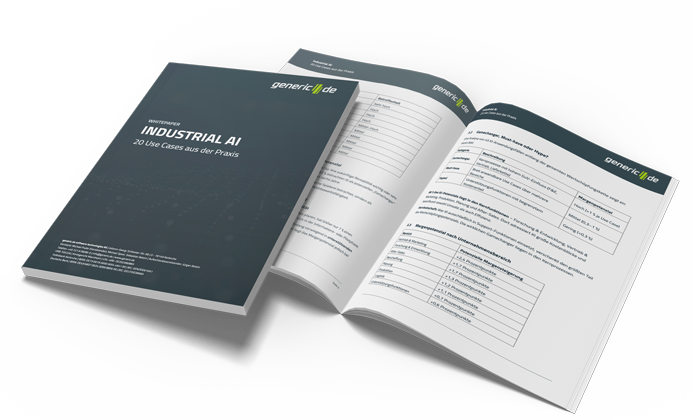
KI in der Industrie ist kein Zukunftsthema mehr, aber wo lohnt sich der Einstieg wirklich? Dieses Whitepaper zeigt 20 anonymisierte Praxisbeispiele, wo KI heute in Kernprozessen messbaren Mehrwert liefert – von Qualitätssicherung über Predictive Maintenance bis zur intelligenten Produktionsplanung.