Data-driven decisions — with custom BI software for your company

Content:
- What is business intelligence software?
- Why are standard BI tools often insufficient for complex corporate structures?
- When does individual BI software make sense?
- Comparison: standard BI vs. individual BI software
- Which use cases can be implemented with individual BI software?
- What are the technological advantages of customized BI software?
- How we develop your individual BI solution
- The most common questions about business intelligence software
What is business intelligence software?
BI software (business intelligence) is a data-driven decision-making tool for collecting, preparing, analyzing, and visualizing company data. It transforms large volumes of data into dashboards, charts, and reports. Typical features include real-time analytics, self-service BI, and the integration of data from diverse sources. Modern business intelligence software is more than a reporting tool — it forms the foundation for data-driven corporate management, transparency, and sustainable growth. Outstanding BI software offers the following capabilities:
- Holistic data integration: It consolidates structured and unstructured data from all source systems (ERP, CRM, production, IoT, DMS, etc.) into a unified, always up-to-date database. Interfaces and API-first approaches ensure long-term future-proofing.
- Self-service & ease of use: Modern BI solutions rely on intuitive interfaces that enable decision-makers to create their own reports, dashboards, and analyses without IT dependency. AI-based recommendations further simplify access to insights.
- Automation: Best-practice BI automates recurring tasks — from data preparation and plausibility checks (e.g., using machine learning) to alerting for critical thresholds.
- Scalability & security: The architecture and infrastructure are cloud- and hybrid-ready, enabling growth alongside increasing data volumes and evolving requirements. Compliance with GDPR, ISO, and industry-specific standards is ensured from the outset.
- Extensibility & customization: The solution can be flexibly adapted to individual workflows, roles, and processes — an essential requirement for complex or historically grown structures.
- Actionable insights: Key decision-making information is not only presented in a visually compelling way, but also directly supplemented with concrete options for action — such as automated workflows or recommendations derived from predictive analytics.
Why are standard BI tools often insufficient for complex corporate structures?
Many companies invest in business intelligence to make data-driven decisions and gain transparency over their business processes. In practice, however, standard BI tools such as Power BI or Tableau frequently fall short when confronted with the reality of established corporate structures. According to Fortune Business Insights, the global BI software market is projected to grow from USD 52.89 billion (2026) to over USD 150 billion by 2034 — a clear signal that the demand for data-driven decision-making is enormous. Yet market growth alone will not solve operational challenges.
In practice, the following obstacles are common:
- Data silos everywhere: ERP, CRM, production, HR, document management — each system maintains its own data, its own formats, and its own version of the truth. Standard BI tools are often unable to fully represent this heterogeneous landscape. Monthly financial closing processes require days of manual consolidation due to the absence of a unified database.
- Decisions based on gut feeling rather than real-time data: Reports are already outdated by the time they are delivered. Investment decisions rely on Excel estimates instead of reliable figures. Management lacks consolidated real-time data for sound corporate governance.
- Non-linear processes that standard tools cannot represent: Many companies have developed highly individual business processes over decades. Standard BI platforms, however, require linear, standardized processes — and fail to reflect the actual way work gets done.
- Fear of a tool jungle: Every department demands a different solution. The result is redundancy, training costs, and even more data silos. Instead of simplification, complexity grows further — and costs rise without any improvement in transparency.
- Compliance pressure without a solid data foundation: ESG reporting, CSRD, the Supply Chain Due Diligence Act — regulatory requirements demand consolidated data that is currently scattered across multiple systems. Manual collection introduces the risk of errors and personal liability.
Sustainable added value only emerges when BI software is precisely tailored to an organization's own system landscape, processes, and decision logic — through custom development rather than the configuration of a standard platform.
When does individual BI software make sense?
Business intelligence describes a set of technological processes for collecting, managing, and analyzing company data in order to generate insights that support business strategy and operations. The potential is significant: clearer reporting, consolidated data, new efficiencies, and faster decisions. But the decisive question is not whether to use BI, but how. Organizations with individual processes, heterogeneous systems, and established data structures need a solution that fits them precisely.
Full control over your data architecture: You determine which data sources are connected, how data is processed, and where it is stored. There are no restrictions imposed by prefabricated connectors or escalating licensing models. The architecture — whether data warehouse, data lakehouse, or streaming — is tailored to your specific requirements.
Business logic that represents your processes: Custom BI software models your actual decision-making workflows — even when they have evolved non-linearly, are industry-specific, or have grown historically. Rather than adapting your processes to a tool, the software adapts to your reality.
Seamless integration with existing systems: Whether Infor ERP, SAP, CAS CRM, Redmine, or proprietary databases — a custom-developed solution bridges your systems and delivers a consolidated, unified database: a single source of truth. Media breaks are eliminated and data can be used across systems.
Future-proof and expandable: Your company evolves — and your BI software grows with it. New data sources, additional KPIs, AI-based analyses, and predictive analytics can be incorporated at any time, without dependency on a vendor's release schedule and without additional licenses.
Custom BI software pays off in the long term — not only technically, but also economically.
Which use cases can be implemented with individual BI software?
Individual BI software provides the greatest leverage where standard tools reach their limits: with heterogeneous data sources, complex decision-making processes and industry-specific requirements. The following use cases show how companies create concrete added value through tailor-made business intelligence.Custom BI software delivers the greatest impact precisely where standard tools reach their limits: with heterogeneous data sources, complex decision-making processes, and industry-specific requirements. The following use cases illustrate how organizations generate concrete added value through tailor-made business intelligence.
Use Case 1: Real-Time Financial Dashboard
Operational results, margins, cash flow, and contribution margins from ERP, CRM, and production are consolidated in a single dashboard — in real time, without manual merging. The CFO has a clear view of the company's financial position at any moment, without waiting days for the monthly close.
Outcome: Monthly financial closing reduced from 5 days to just a few hours. Controller capacity freed up for value-adding analysis instead of copy-paste work.
Use Case 2: Data-driven Sales
Cross-selling potential, pipeline risks, and per-customer margins become visible by consolidating CRM and ERP data. Sales teams act proactively rather than reactively — with a reliable data foundation for every customer conversation.
Outcome: 60 minutes saved per customer visit through consolidated information. Revenue growth through systematically identified cross-selling opportunities.
Use Case 3: Compliance Reporting (ESG, CSRD, LkSG)
A consolidated data foundation for regulatory requirements. Audit-ready reports at the push of a button instead of error-prone manual processes. Data from multiple source systems is automatically combined and prepared.
Outcome: Compliance security without last-minute panic. Reduced liability risk through auditable, consolidated data.
Use Case 4: Production monitoring & key figure analysis
Production figures from heterogeneous sources — machine utilization, downtime, OEE — are combined and visualized in drill-down dashboards. Bottlenecks and inefficiencies become visible before they generate costs.
Outcome: 30% fewer unplanned downtimes through early pattern recognition. Full transparency over production costs per unit.
Use Case 5: Knowledge Management & Document Intelligence
Equipment files, invoices, quotations, and technical documentation become fully searchable. AI-based indexing enables users to "chat" with documents and makes implicit knowledge digitally accessible — regardless of where it is stored.
Outcome: Search times reduced by 70%. Knowledge loss during employee transitions minimized. New employees become productive faster.
Use Case 6: Predictive Maintenance
Clean, consolidated data as the foundation for predictive maintenance and automated process optimization. Without a reliable data basis, every decision remains a matter of gut feeling — data first, then BI software.
Outcome: ROROI achieved within 6 months through data-driven forecasting. AI readiness established as a strategic competitive advantage.
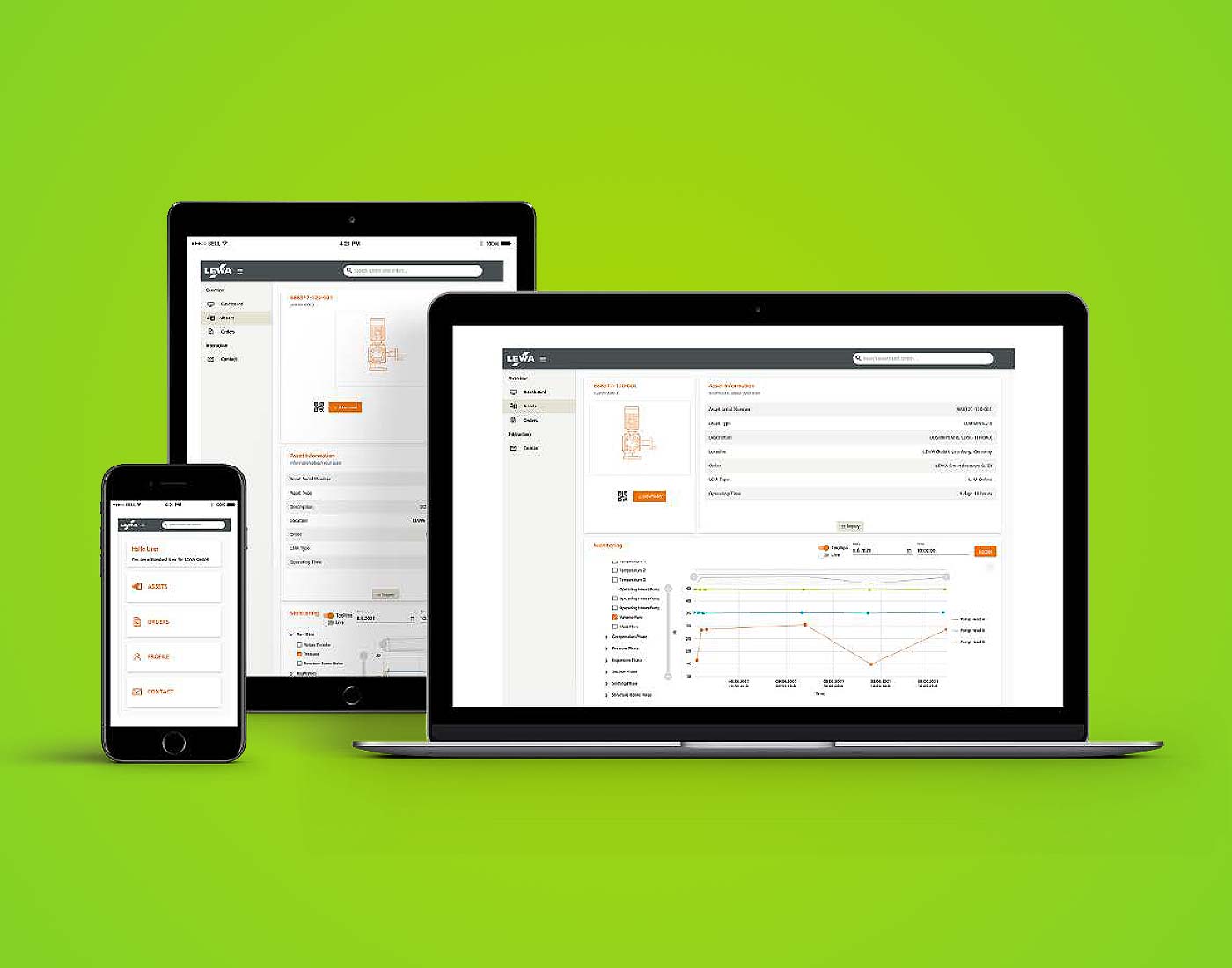
”Since everyone is interconnected and shares the same project knowledge, it simply works — saving time and money otherwise spent on explanations, knowledge transfer, management, and coordination."— Moritz Pastow, Digital Services Program Manager, LEWA GmbH
Click here to check out our LEWA showcase: IoT platform for industrial pumps
What technological advantages does tailor-made BI software offer?
Custom BI software is built on proven, open technologies — developed according to clean code principles to ensure the solution remains maintainable, extensible, and independent over the long term. The architecture is shaped by your requirements, not by the limitations of a platform. Whether cloud, on-premise, or hybrid: you retain full control.
- Open interfaces (APIs): Seamless connection to ERP, CRM, MES, DMS, and legacy systems via REST, GraphQL, or custom connectors — including on-premise infrastructure.
- Scalable data architecture: From data warehouse to data lakehouse to streaming architectures — the right solution for your data volume, real-time requirements, and growth plans.
- AI and ML integration: From clean data to predictive analytics and automated insights — AI-ready from day one, without retrofitted add-on modules.
- Data security and governance: Access rights, GDPR compliance, data lineage, and automated quality monitoring are integral parts of every solution — not afterthoughts.
- Platform independence: No vendor lock-in. The code is yours. Your team can develop or extend the solution independently at any time.
How we develop your individual BI solution
Stage 1: INVENT (1-2 weeks)
Current state and target analysis. Which data sources exist? Which decisions should be grounded in data? We map your system landscape, prioritize use cases, and identify quick wins. The result: a clear roadmap instead of unstructured project chaos.
Phase 2: EXPLORE (4-8 weeks)
Assessment of existing data sources and their suitability for analytics. Concept development, interface definition, and architecture design. Using a data-thinking approach, we identify additional relevant data sources and refine the project scope.
Phase 3: DEVELOP (from 6 weeks, iterative)
Agile development of custom BI solutions with iterative releases. First dashboards and consolidated insights are delivered within weeks. The solution is gradually extended to include additional data sources, KPIs, and analyses. We work in mixed teams — our technical expertise combined with yours.
Stage 4: RECEIVE (continuous)
Operations, support, and continuous development. Ongoing monitoring of data quality and relevance. Knowledge transfer and team enablement so that your internal team can progressively take on ownership.
Why generic.de is the partner for individual BI projects
We do not develop standard solutions that are then adapted to fit your processes. We develop software that understands your processes — from day one.
Custom software instead of platform thinking: No escalating license costs, no vendor lock-in. We develop precisely the BI solution your company needs — nothing more, nothing less. The intellectual property belongs to you.
Clean code and quality standards: Clean, well-documented code that remains maintainable and extensible over the long term. No technical debt that will surface two years down the line.
Deep expertise in data consolidation and integration: From heterogeneous ERP landscapes to legacy systems and cloud connections — we bring your data together and establish a single source of truth, even in complex on-premise environments.
Results in weeks, not years: An iterative MVP approach delivers first visible results within weeks. No big-bang risk, but steady development with measurable ROI. After 8 weeks, the first dashboard is live.
The most common questions about business intelligence software
- What is business intelligence software? Business intelligence (BI) software encompasses the technologies and processes used to collect, manage, and analyze company data. The goal is to extract meaningful insights from raw data that support strategic and operational decisions — from real-time dashboards to automated reports and predictive analytics. As IBM puts it, BI "provides the ability to explore data to understand trends and derive insights."
- When is individual BI software worthwhile instead of a standard platform? As soon as a company operates heterogeneous systems — multiple ERPs, CRM platforms, production systems — or has non-linear processes and specific reporting requirements, standard solutions begin to reach their limits. Custom BI software becomes worthwhile when the costs of workarounds, manual reporting, and rising license fees outweigh the investment in a tailored solution.
- How is business intelligence different from business analytics? BI is descriptive: it provides transparency about current and historical business data. What happened? Where do we stand? Business analytics goes a step further, delivering predictive and prescriptive insights: What is likely to happen? What should we do? Custom BI software can cover both — from consolidated dashboards to predictive analytics.
- How long does it take to implement an individual BI project? First visible results — such as a consolidated management KPI dashboard — can be achieved within 6 to 8 weeks. Full expansion across multiple data sources and advanced analyses is carried out iteratively over several months. We recommend starting with a focused pilot project that delivers measurable value quickly.
- Does a new IT infrastructure have to be set up? During the analysis phase, we need access to the relevant business units and data sources. Throughout the project, we work in mixed teams: we contribute the technical expertise, you contribute the domain knowledge. The goal is to enable your team to develop independently — not to create a permanent dependency, but to transfer knowledge.
- Is individual BI software the basis for AI? Yes Clean, consolidated data is the prerequisite for every AI use case — whether predictive maintenance, demand forecasting or AI-supported process automation. “Learn first, scale second.” An individual BI solution creates exactly this foundation on which AI can build.
- What investment should I expect? The investment depends on the size. We recommend starting with a focused pilot project that delivers measurable ROI within a few weeks. This allows you to validate the added value before you scale—without the risk of big bang and without making a commitment to the long term.
About generic.de
For over 25 years, generic.de has been helping industrial companies set up their BI landscape independently and future-proof — transparently, comprehensibly and without vendor lock-in. Through Clean Code Development, Dual Track Agile and consistent knowledge transfer, your reporting and analysis expertise stays with you — even though the people who built it are no longer there.
Do you need a BI solution? Write to us at [vertrieb@generic.de] or call [+49 721 6190960] — we'll get in touch within 24 hours.
Sources & references
- IBM — What is business intelligence?
- Fortune Business Insights — Business Intelligence Software Market