Your departments build their own tools with AI – we provide the framework
Why set up the Agent Harness with us?
A shared AI framework for your department
Without a common framework, everyone sets up their own AI workspace. This leads to private code without standards. In the harness, everyone works with the same guidelines and tests. We keep this framework up to date for you.
Because the description defines the tool
Every tool begins with a functional spec. This defines what the tool is supposed to do. If requirements change, your department updates the spec. The harness then regenerates the small tool accordingly.
Because someone on your team gives the final approval
Guard rails provide the agent with firm guidelines. Quality gates automatically check every result. A passed quality gate serves as an indicator. A tool is always approved by someone within your organization.
How an Agent Harness works
An AI agent is a program that uses a language model to complete tasks autonomously. The Harness defines which tools the agent uses and which rules apply. It also determines the sequence of work steps.
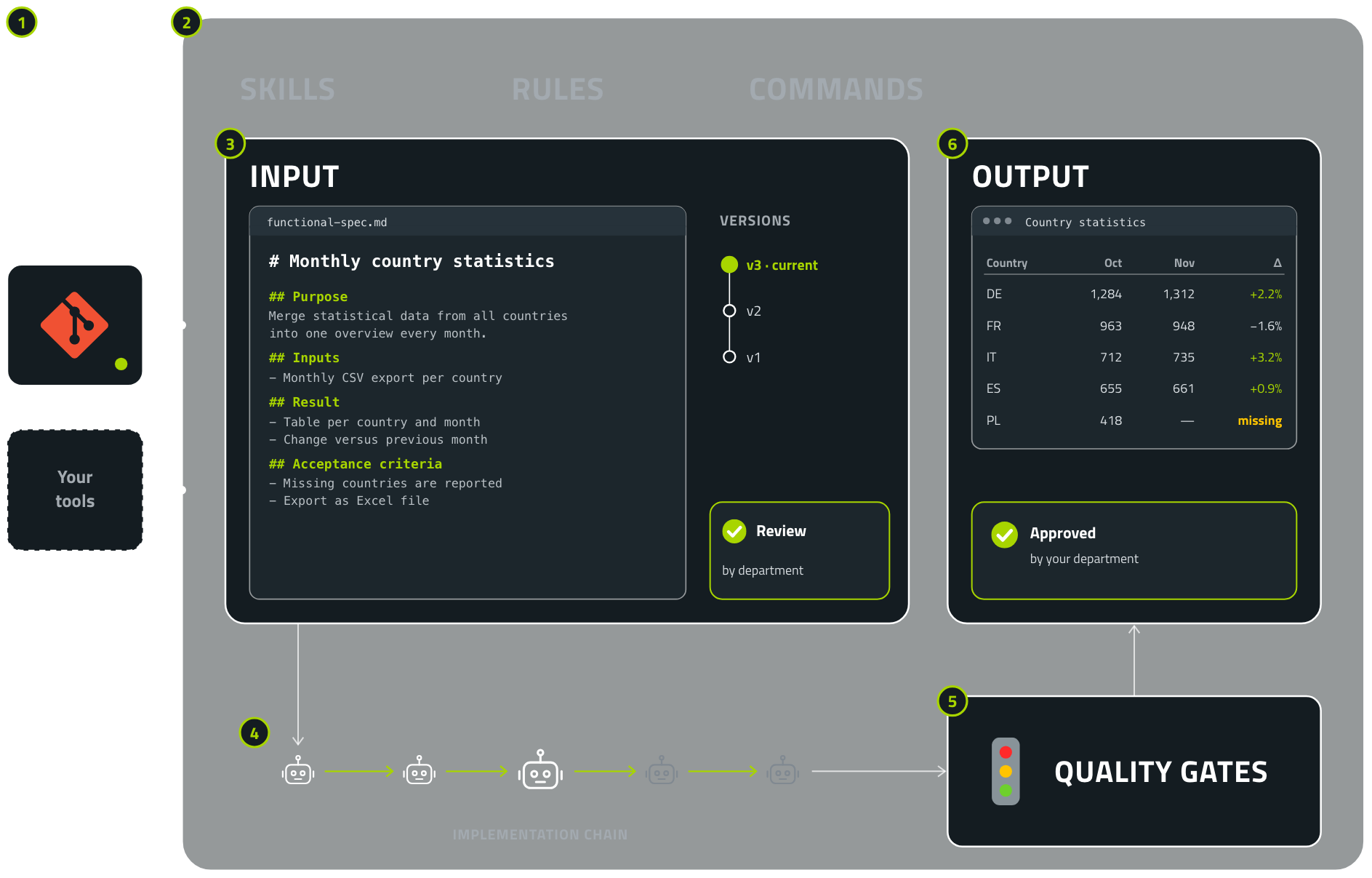
1 Tools
The agent only works with tools defined in the harness. This always includes Git, the version control system, where the spec and code are stored. You decide where the finished tools run.
2 Skills, Rules, Commands
Skills are proven workflows. Rules define what an AI agent is allowed to do and what it isn't. Commands trigger recurring processes at the push of a button. The Harness is never finished. We incorporate feedback from your department on a regular, fixed schedule.
3 Functional Spec
Your department describes what a tool should be able to do. This description is called a functional spec and is stored as a versioned Markdown file. Someone from your team reviews it before the agent begins. You maintain the spec, not the code.
4 Implementation Chain
The Harness breaks the spec down into individual development tasks. AI agents process them in a fixed sequence of steps. Guard rails define the permitted technologies and tests.
5 Quality Gates
Every result undergoes automated checks: linters, static analysis, and tests, including end-to-end tests. A green quality gate is an indicator, not an approval.
6 Tool and Approval
The end result is a small tool for your own workplace. Someone from your team checks it against the spec and approves it. If requirements change, you simply update the spec and the Harness regenerates the tool.
What Harness as a Service includes
Your specialist department defines the requirements for a tool. This specification is version-controlled as a Markdown file. Markdown is a simple text format that is readable by both humans and agents.
The Harness breaks the spec down into individual development tasks. These tasks pass through a fixed sequence of work steps. This is the Implementation Chain.
Guard rails are fixed requirements for the agent. These include the permitted technologies and tests, including end-to-end tests. End-to-end tests verify the tool exactly as it will be used in practice.
Quality gates are automated checks performed before every handover. They scan the code for errors and policy violations. Only after passing these checks is the code reviewed by someone from your organization.
We collect feedback from your department and regularly incorporate it into the harness. The maintained harness remains with you.
Book a discovery call now
Frequently asked questions about Harness as a Service
Who is Harness as a Service intended for?
For departments that want to create small tools for their daily work themselves. The people there should not have to learn to code or set up a dedicated project. If you are looking for support for your development team, our AI Services & Enablement are the right fit.
What kind of tools are created in the harness?
Single-user tools are created for individual workstations. One example is a tool that consolidates statistical data from many countries every month. Previously, your staff had to create a custom Excel spreadsheet for this.
What happens if a tool needs to be scaled up?
If a tool outgrows the scope of a single-user application, it is further developed rather than recreated. If it is intended to become software for widespread use, it will be developed professionally. This is a separate project outside the scope of this service.
What do we need to provide?
You designate a person responsible for providing feedback on the harness. Someone from your organization reviews every spec before development begins. Your code must be stored in Git. Git is a version control system that the agent requires as a foundation for its work. You define where the tools run and within what boundaries.
Which technologies does the harness work with?
The architecture is not tied to any specific technology. The guard rails determine which technologies your tools use.
What exactly is an agent harness?
The language model is the engine; the harness is the vehicle, the road, and the traffic rules. It encompasses everything that makes a model usable within the company: rule sets, integration with your tools, workflow control, guardrails, logging, and approval points. The vast majority of the impact comes from here—not from the model itself.