supply chain solutions
Additive manufacturing is no longer a niche topic. Companies are integrating 3D printing into their series production and supply chains – and for this, they need software that connects digital designs, physical production, quality assurance, and traceability into one end-to-end system. Standard solutions reach their limits here: they are too rigid, too generic, and lack integration capabilities.
In practice, typical challenges arise:
Through our work with companies like Rapid Shape and WÜRTH, we know how the additive manufacturing industry works – from printer fleets to license billing.
Thanks to our AI-driven software development, we deliver features up to 3x faster. You can start testing sooner and get real user feedback earlier – while changes are still cost-effective.
We are convinced that even in the AI era, industrial software must run for decades. That is why our clean code standard applies to AI-generated code as well. For sustainable, not disposable software.
The source code, concepts, designs, and the AI development environment belong to you. You could continue working with your own team tomorrow. We keep clients through results, not lock-ins.

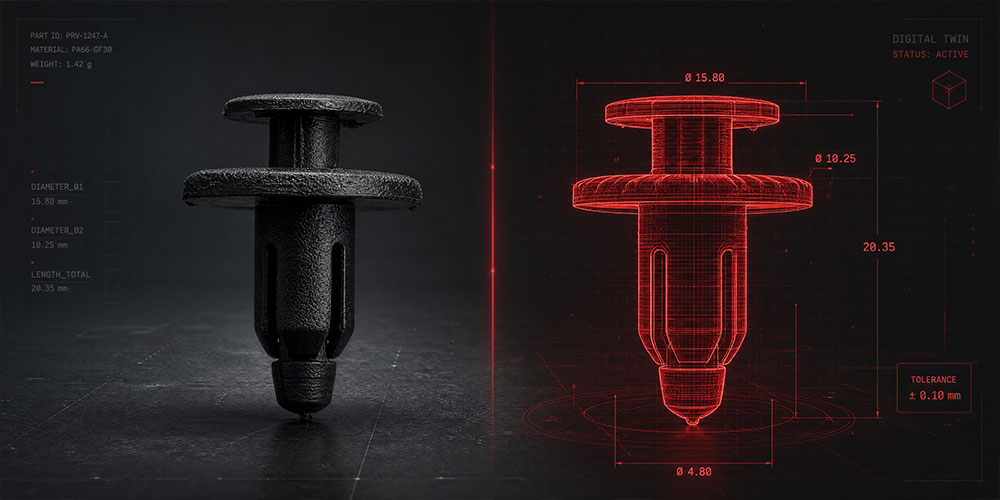
Replace physical warehouses with digital inventories: components are manufactured on-demand as soon as they are needed – quality-assured, traceable, and seamlessly integrated into global supply chains. Connect heterogeneous machine fleets into a unified data landscape. With OPC UA, MQTT, and edge technology, we create the foundation for all further digitalization steps: from condition monitoring to the digital twin.

Document every component seamlessly – from the CAD file and process parameters to the inspection result. Compliant, audit-proof, and integrated into existing quality management systems. Leverage operational data from sensors and controls to predict maintenance needs and prevent failures. Across all industries, unplanned downtime can be reduced by 30 to 50% – using ML models, time-series analysis, and intelligent dashboards.

Intuitive user interfaces, process control, and data connectivity for 3D printing system manufacturers – user-centric, maintainable, and designed for professional industrial use.

Seamlessly integrate additive manufacturing into your existing enterprise landscape: from ERP order initiation and production orders to delivery confirmation – end-to-end, automated, and data-driven.
Together, we analyze your processes and identify your use cases. From there, we develop ideas for software solutions. If you already have a specific idea, we evaluate it for business viability and technical feasibility.
We design your software solution at the intersection of biz, tech, and user requirements. The result is a sophisticated solution concept structured as a machine-readable knowledge graph – perfectly suited for development with AI agents.
Development in Dual Track Agile: In our AI development environment, AI agents handle routine tasks, code, and testing according to clean code standards. Our experts continuously design, verify, and enrich the knowledge graph.
We operate and maintain your software, monitor system performance, and ensure sustainable, secure operation through regular updates and ongoing technological development.
A software project is worthwhile when manual ordering and manufacturing processes create bottlenecks, quality data is not consistently available, or scaling to multiple locations is impossible without integrated software. Typical KPIs include reduced inventory costs, shorter lead times, lower scrap rates, and faster certification processes.
Digital manufacturing data is sensitive intellectual property. We integrate access controls, encryption, and audit-proof logging into the architecture from the very beginning – for both cloud and on-premises scenarios.
Yes. We have experience integrating a wide variety of machine interfaces and manufacturer protocols. The existing machine landscape is not replaced, but rather integrated into a continuous software platform.
Through seamless data collection across the entire manufacturing process: CAD versions, process parameters, material batches, test results, and delivery documentation are recorded in a structured manner and archived in an audit-proof way – serving as the foundation for compliance documentation and quality audits.
Servitization describes the shift from pure product sales to data-driven business models: equipment-as-a-service, pay-per-use, remote monitoring, and digital after-sales platforms. Standard software often reaches its limits here because business models must be closely integrated with machine logic, customer processes, and the existing IT landscape. Custom software can act as the bridge between the machine, the data, and the new business model.
Small and clearly defined: a manageable use case with recognizable benefits – e.g., printing processes, a pilot customer, or a specific service use case. The goal is to gain quick, well-founded insights and experience with technology, organization, and interfaces. Starting this way reduces risks and makes the actual value easier to evaluate. Afterward, the software can be expanded in a targeted manner – to include additional processes, regions, data sources, or functions.
Typical points of contact include product/development, application engineering or service, IT, and, if necessary, maintenance or quality assurance. The size of the team is less important than having clear responsibilities and decision-making processes. Knowledge of 3D printing and processes is just as important as expertise in integration and operations. Regular communication between all stakeholders contributes significantly to success.
The duration depends heavily on the scope, the existing system landscape, and the integration effort – ranging from a few months for focused enhancements to longer timelines for comprehensive platforms or numerous interfaces. Pilot projects provide reliable results early on and help to realistically assess effort and roadmaps.